How Big Were the Norse Giants?

The other day I was wondering “How big is a giant?” It is a simple question and I can give you a simple answer – it varies. The giant who built the walls of Asgard was able to change his size so that the gods did not suspect his true nature. This ability prevents us from getting a satisfying answer to our question. Unfortunately, the Eddas don’t have a section that comes right out and lists the heights of the giants, or jotnar. We have to settle for bits and pieces. A description of Jotunheim mentions that the place is filled with men of “prodigious stature.” That doesn’t tell us much. Utgard-Loki, the king of the giants, says “Thor is little in comparison to our men.”  I assume Thor had to be at least six feet tall so we’re starting to make some progress here. There are other sections where we can pick up clues from comparisons but ultimately we learn that there are jotnar of all different sizes. Here are some of them:

Big
Whether naturally, or by altering themselves with some sort of shape-changing ability, the Jotnar could not have been that much taller than the gods because several of the gods married giantesses and had children with them. There was Loki and Angrboda. Now we could discount this since Loki was half-giant and a shapeshifter himself, but Thor fathered a child with Jarnsaxa, Odin seduced Gunnlod, Frey married  the giantess Gerda, and Skadi married Njord. So due to simple biology we have to assume at least some of the jotnar were close in size to the gods.

Bigger
During the funeral of Balder the Good he was laid to rest in his ship Hringhorn. The ship was “the largest in the world” and was filled with all manner of goods and treasures. But when it came time to launch the ship it was so heavy that no one was able to budge it. They summoned a giantess named Hyrrokin. She arrived riding a wolf. Her mount was so big that it took four beserkers just to hold it down. Hyrrokin was able to get the boat unstuck with a single push. Considering that Odin and Thor were already there and they still had to send out for help, we begin to get the idea this had to be a seriously massive woman.

But can we find a clearer example of size? Sure. Thor and Loki and two human companions were on one of their adventures when they were forced to take shelter for the night. They found a strange hall which was all open on one side. During the night they were awakened by strange noises and retreated into one of the side rooms so Thor could more easily stand guard at the entrance. When morning came and they ventured outside they discovered the giant Skrymir. The strange noises were caused by the giant’s snoring. The giant talked with them a bit and then picked up his glove at which point Thor realized that the “hall” they had spent the night in was the in fact the giant’s glove. The side “room” had been the thumb of the glove. Four people had fit into that “room.” If his thumb was that big, imagine how big the rest of him was.

Biggest
How big could the giants get? Consider this – the world was formed from the body of the giant Ymir. The sons of Bor (Odin, Villi and Ve) slew the first giant and used his flesh to make the earth, his bones to make the mountains, his blood to make the sea, and they used his skull to make the sky. Now that is big!
Posted by Mark Neumayer

Dwarven Valkyries

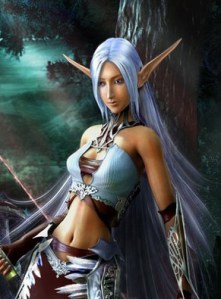
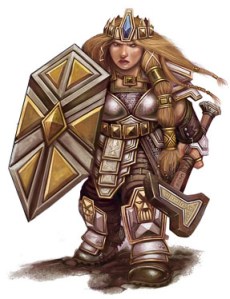
Forgotten Realms female Dwarf concept art

Usually when I write about mythology on the blog I am using the sagas as my source material (the Prose and Poetic Eddas, most often.) So I can understand how people might get a bit confused after reading the promo copy for my book Valda & the Valkyries. The book is about the adventures of a 15 year old Dwarf girl who becomes a Valkyrie. I want to be upfront about this – the book is fiction. While it is based on Norse mythology and uses characters from the myths, I made up the story. Also, I have not read any sagas that mention Dwarves being Valkyries. And yet the idea that a Dwarf could become a Valkyrie is not as crazy as it seems at first.

Bear with me for a bit as I first talk about the Norns. The Norns were the magical entities who ruled over the destinies of god and man. We know the names of the three most prominent ones: Urd, Verdandi and Skuld. Their names roughly translate to “that which happened,” “that which is happening” and “that which should occur” or, to be more blunt: past, present and future. Henry Adams Bellows writes

In Vafthruthnismol, 49, the Norns (this time “three throngs” instead of simply “three”) are spoken of as giant-maidens.

This, and one of the passages in Voluspa, could lead us to believe that the Norns are Jotun, or giantesses. However that may be, we are also told specifically that there are more than three Norns. The three chief ones we have already mentioned determine the destinies of mankind, the others watch over an individual throughout their life in a role similar to the Christian concept of the guardian angel.

Going to Voluspa again we can read:

‘Methinks the Norns were born far asunder, for they are not of the same race. Some belong to the Æsir, some to the Elves, and some are Dvalin’s daughters.”

Dvalin was a famous dwarf, so Dvalin’s daughters would be a kenning for dvergar, or dwarves. So in this passage we learn that the lesser Norns could be any of several races, including the Dwarves.

Back to the Valkyries – as I wrote about in this article, human maidens could, under the right conditions,  become Valkyries. We also know that Skuld was a Valkyrie and a Norn and that she might have been a giantess. So while my conclusion is not official in any way, shape or form, it seems to me it isn’t that far-fetched to assume that a Dwarf, who we know could be a lesser Norn, could also become a Valkyrie. What do you think?

Posted by Mark Neumayer

Guest post at Viking Runes blog

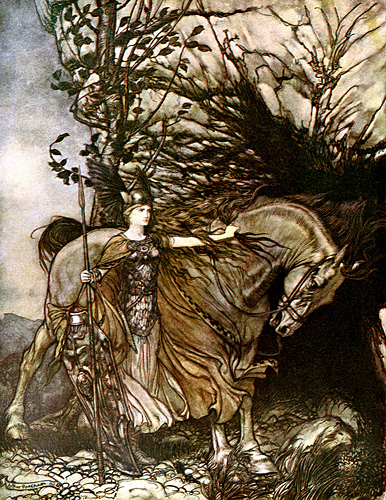
Arthur Rackham painting for The Ring of the Niblung

Just a quick mention that I did a guest post for the Viking Rune blog. You can find my article on the Valkyries here. It’s a bit more in-depth than the posts I write for my own blog.

And while you’re there you should check out some of the cool stuff on Victor’s site. There is a rune converter that will change your name or other English words into any of several different rune alphabets. There’s a app you can use to make your own Viking motto in Old Norse. He also has some interesting articles on different Viking runes and even an analysis of the Norse mythology links in the Max Payne video games and movie. Check it out!

Fast Facts About the Elves

Most people who follow fantasy know about the elves. Ask almost anyone and you’ll hear something like:  “Elves? Graceful fairy-type folk. Awful good with a bow. Pointy-eared, close to nature folks.” That is what we know but there is still a lot that we don’t know.

Norse Saga Elves
The Norse sagas provide us with the earliest recorded description of the elves or álfr. The elves seem to be a bit closer to the gods than mortals. Their home of Alfheim is described as being in the heavens. (It is also listed as one of the Nine Worlds of Norse mythology.) We are told that humans are sometimes raised up into the ranks of the  álfr. Human and elf are even able to cross-breed. King Alf of Alfheim and his line are said to be more handsome than most men due to the presence of Elf in their bloodlines. Elves even seem above the physical restraints of the body, being able to walk through walls and doors. This magical nature extended to their ability to wield witchcraft. The half-elf woman Skuld was so skilled that she could raise the fallen members of her army almost as soon as they were killed. Elves could even become Nornir, going to a child when it was first born and helping to shape its life – pretty much along the lines of the later idea of guardian angels.
The thing that was missing for me was stories about Alfheim, we hardly know anything about it at all. It is named as one of the Nine Worlds but we don’t have any stories that tell us what it is like. We have no adventures that happen there. All of the legends and folktales revolve around elves or half-elves in the world of the humans. This struck me as being so odd that I even worked it into my first novel, Valda & the Valkyries, where I have this odd blind spot accounted for by a convoluted plan set into motion by Loki.

Shakespeare’s Elves
The bard used elves most famously in A Midsummer Night’s Dream, but these elves are more a blending of elf and fairy than a pure descendant of the Norse sagas. They do exhibit more of the mischievous nature that elves of folklore possessed.  While they are at time referred to as fairies we find the terms almost interchangeable in the poetic sense. We still have elf and fairy exhibiting that great, other-worldly beauty, but they are smaller creatures and their grace is tempered with a truly playful nature. He made them somewhat silly, which is something our next entry never forgave him for.

Tolkien’s Elves
It is fair to say that JRR has done more to influence the popular conception of elves than anyone else. His version of the elf is the one that springs to mind for most people. For Tolkien, elves were majestic, larger-than-life creatures “admired by every race.”  JRR has them as the eldest and noblest of the speaking races. He follows the Norse tradition of elves not being that much different in appearance from humans but nonetheless being of a somewhat higher race. While he wasn’t a full on Luddite Tolkien did care much more for the pastoral countryside and the elves of his stories are the guardians and the very embodiment of nature. He hated what he thought Shakespeare had done to elves, writing:
“I now deeply regret having used Elves, though this is a word in ancestry and original meaning suitable enough. But the disastrous debasement of this word, in which Shakespeare played an unforgivable part, has really overloaded it with regrettable tones, which are too much to overcome.”

Rowling’s Elves
We’ll close this off with the elves from the Harry Potter series. These strike me more as elves in name only. Their apperance is more like gnomes or some other sort of fairy creature, to be honest. They are short in stature, fairly ugly, with bat ears and bulging eyes. Their connection to the original source material seems to consist mainly with their magical nature. House elves can perform magic, mostly in the service of their master but are bound by numerous limitations to what they can do. The house-elves are  a subservient slave class, certainly nothing like the demi-gods of the sagas.

If you want to read more about elves I’d like to suggest the following pages for you:
Lord of the Rings wiki page on Elves
Elves from the Lord of the Rings to Shakespeare
Elves page on Wikipedia

Posted by Mark Neumayer

5 Sources for Learning About Norse Myths

Part of writing is doing your research. Not that long ago this would have meant hours spent searching through dusty shelves and traveling to different libraries. Luckily we have the internet now and some great resources are brought right into our homes. This week I wanted to share some of the online resources I used while I was writing my novel Valda & the Valkyriesand it’s forthcoming sequel Valda Goes Through Hel.  This isn’t meant to be an exhaustive list ( I have over 3 dozen links in my Norse reference bookmark folder) but it is certainly a great place to get started in your own studies.

The Viking Answer Lady
While there is information on this site about Norse mythology, the majority of it deals with various day to day information about the lives of the Vikings. Lots of good details to be found here about old Norse food, clothing, agriculture, warfare and more. Typical pages lay out solid information and give you a listing of resources where you can dig for more.

Sunnyway.com
This web site has a lot of information about the Norse runes. But, to quote them “The runes are inextricably bound to Norse mythology. One who aspires to be a user of runes needs a working knowledge of the mythology and writings of the runic era.” So what this site has done is put together an incredibly comprehensive listing of god, goddesses, giants, dwarves and wights. But they don’t stop there, going on to list different kennings and references and just tons more good stuff. They break it down into an alphabetical listing starting here.

Godchecker.com
This web site covers many different mythologies with a healthy dose of attitude. If you prefer a little snark and sass with your Norse research Godchecker.com is a good place to find information on over 102 gods, goddesses and various other creatures from the Norse mythos.

Wikipedia
While there have been questions from time to time about the accuracy of entries on this site, there is no argument that Wikipedia is the go-to site for online encyclopedias. So it’s no surprise that they have a lot of information on the Norse myths. The articles are generally well-written and close out with further reading suggestions and links. There is artwork referenced in many of the articles and those from Wikimedia Commons are even in the public domain and available for use.

Sacred-Texts.com
There is nothing like going straight to the source for your information. On this website you can find English translations of the Prose and Poetic Eddas along with many other sagas. Storytelling has not really changed that much over the centuries and the works found here are entertaining as well as educational.

Feel free to add any links that you’ve found useful in the comments!

Posted by Mark Neumayer

Fast Facts About the Viking Undead

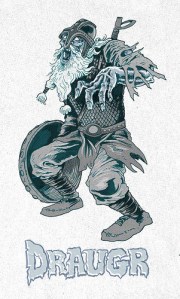
Illustration by Aaron Klopp

The Draugr

Zombies have been a mainstay of horror films and fiction for a long time. It’s not surprising to find out that they also had tales about them in the Norse sagas. There they were called draugr. I’ve been researching them since the draugr play a major part in my next book – Valda Goes Through Hel.  Here are some fast facts about the Norse version of the undead.

Undead Sing the Blues
Although they were described sometimes as having pale flesh or skin as black as Hel, I think the scarier descriptions are those which tell about draugr with an evil blue skin color. The Norse were no strangers to living the rough life and we can expect they were intimately familiar with the various funky colors your skin can take on from various bruises and injuries. Imagine that sickly dark bluish tinge of a deep bruise covering every square inch of someone’s body. You would not want to run into something like that on a dark night.

Ch-ch-ch-changes
The draugr have also shown the ability to shape-shift. There stories where they assume the form of various creatures such as a seal, a bull, a horse and even a cat. While that last one doesn’t sound so menacing, once the draugr had assumed a cat’s form it would lay on the chest of a sleeping person and gradually get heavier and heavier until it crushed its victim to death.

That’s Heavy
It wasn’t just in feline form that the draugr possessed great weight. They were said to be heavier than a normal corpse. Some of them were described as having swollen bodies “as big as an ox.” This gave them great strength and they loved to use it to batter down doors and bash their way into the halls of the living. They would even indulge in an activity called house-riding. This consisted of the draugr climbing onto the roof of a house and drumming its heels against the roof to terrify everyone inside while they tried to bring down the rafters.

Hungry, Hungry Haugbui
Haugbui is another name for the undead. The name derives from the Norse word for barrows, or grave, so haugbui are grave-dwellers. The main difference seems to be that haugbui stayed relatively close to their graves while the draugr were more likely to roam the countryside. One of the traits that they did share was an immense hunger. There is a tale of a newly-risen draugr that eats the hunting hawk and dog that were buried with him. The next night he rises again and devours the horse that was buried with him. The third night he attempts to eat his friend who has been watching the gravesite. As a side note, that is indeed a good friend. Personally I think I would have been out of there after the first night.

While our Western image of the zombie draws more from the Caribbean influence of voodoo, it’s good to keep in mind the other traditions that have dealt with the undead. Norse mythology certainly has some great twists on the myths. If you want to read a more about draugr an excellent starting point would be this page from the Viking Answer Lady. Her site is a treasure trove of information about the ancient Norse and their ways.

Posted by Mark Neumayer

Talking About Trolls

Screenshot of a stone troll from the Warhammer Online game

Truly epic heroes need truly epic foes. I’ve talked about some of the heroes and creatures in Norse myths before now – this week we bring on the bad guys! The troll most of us know today has evolved considerably since ancient Norse times. The term started out as being a fairly generic term that could also describe a giant or an ogre. In some of the sagas the terms seem to be interchangeable. The one common thread is that trolls are almost never helpful to mankind. They “are perhaps not quite so huge (as giants) but strong, vigorous, unbalanced and nasty.” It was only under the influence of later Scandinavian folklore that the troll became a more distinct being and we see first mention of it being fairly unintelligent and turning to stone when exposed to sunlight.

Straight from the Source
One of the specific trolls mentioned in the Prose Edda is  a unnamed troll woman.  She tells the skald Bragi Boddason that “Trolls call me moon of dwelling-Rungnir, giant’s wealth-sucker, storm-sun’s bale, seeress’s friendly companion, guardian of corpse-fiord, swallower of heaven-wheel; what is a troll other than that?” So we have here established some associations with magic (seeress’ friendly companion) with the dead (corpse-fiord, meaning a grave) and with darkness (swallower of heaven-wheel – the sun.)

Tolkien’s Take on Trolls
The three trolls from The Hobbit follow closely along the lines of the mythical archetype – they are fairly stupid, large creatures who turn to stone when touched by sunlight. They also have a fondness for drinking beer. In LOTR Tolkien brings us many more examples of trolls, going so far as to break them down into different sub-categories: stone-troll, hill-troll, cave-troll etc… Treebeard the Ent says that trolls are a “mockery” of Ents. While some assume them to be a corruption of another lifeform, The Hobbit and LOTR both refer to sunlight turning trolls back into the stone from which they were made.

Detritus
Terry Pratchett’s Discworld series tends to go the comedic route with most things and their treatment of trolls reflects that. Pratchett’s take on the monsters has them constructed from stone. The exact stone varies from troll to troll and there are even trolls composed of brick and the notable Diamond King of trolls is made of the shiny gemstone. While he has done away with the blatantly evil part of the legend, Pratchett has kept the tendency of trolls to be dumb as, well, dumb as rocks. I like the variety of his trolls. They all have the same base core yet the stone they are composed of reflects their locale and origins. If you want to see how Pratchett handles them I would recommend Thud! There are some great scenes in there revolving around the down-on-his-luck troll named Brick.

The Boy Who Lived Through a Troll Attack
The fight with the troll in the girls’ bathroom is a pretty cool scene, especially in the movie version of HP&TSS. While it stays true to the idea of trolls as big and dumb, it doesn’t add much of anything to the lore. JK Rowling pretty much gave us the straight up troll mythos. I really debated whether or not to include this section. While it doesn’t add much to the troll mythos it is true to the older stories and it’s safe to assume that more people have seen this interpretation of trolls than any other one.

It Had to Be Goats
My first exposure to trolls was through the fairytale The Three Billy Goats Gruff in which a trio of goats defeat the troll who prevents them from crossing a bridge. The story is a Norse fairy tale that first saw print in the 1840s and saw it’s first English adaptaion ten or so years later. We can see here the early elements of trolls being evil creatures. We also see the size discrepancy that was common for the earliest depictions of trolls. It would have had to be a really large goat to knock down the sort of trolls we see in the LOTR or HP books. I do have to admit to not quite understanding why they were called “Gruff.” Granted the alliteration is there between goat and gruff. It’s interesting to note that the Norwegian words also begin with the same letter – bukkene and bruse. Maybe it was just to imply that these are the sort of rough and tumble goats that don’t let anyone push them around.

Posted by Mark Neumayer

Skurge’s Last Stand

Skurge’s Last Stand by Walt Simonson

I am a voracious reader, devouring almost any book I can get my hands on. When I was younger my reading diet included a lot of comic books. I have very fond memories of my mom walking me down to the corner drug store where I would spend my weekly allowance on a copy of Spiderman, Captain America or the Fantastic Four. I also found out there were comics about this Norse guy – Thor. I just ate that up. I loved reading the mythology books at the library. (The librarian once tried to get me to go over to the kids section with the other kids and I strongly informed her “No, I like these books.”) Now here were more adventures of the Norse God of thunder in comic book form. Even at a young age I knew that it wasn’t exactly Thor: he didn’t have the red hair and the beard; the mythical Thor didn’t turn into a mere mortal; and the Thor of the sagas never palled around with superheroes in the modern day. But I loved those comics because they were faithful to the spirit of Thor.

My hands down favorite issues of the Thor comics are all from the run of Walt Simonson. For two and a half years in the early 80’s Simonson wrote and drew some simply incredible stories. He updated the characters while keeping them true to the essence of who they were. There is so much to like in that run. Simonson wove a saga around the fire-demon Surtur which led to Ragnarok, the twilight of the gods. He had an unknown warrior from a race of aliens not only beating Thor in combat, but proving himself worthy to pick up Thor’s hammer. Yet I have no hesitation in naming my favorite issue from those 2 1/2 years – it has to be #362 “First Blood, Last Man.” The comic concerns a journey by Thor into the very bowels of Hel to rescue the souls of some mortals. Skurge, the Executioner is a long-time foe of Thor but he accompanies the god of thunder on his mission. Skurge had been, well, let’s be blunt and say he wasn’t the deepest of people. His character revolved around the idea of big strong guy with a magic ax to serve as a foil to Thor, the big strong guy with a magic hammer. But Simonson took this basic character and built him into a story that just resonates and thrills at the same time. Skurge’s actions are unexpected, yet they are a logical extension of who he is. I still get a little chill every time I read his final stand, even after all these years and all the times I have read it.

The Norse myths have inspired my writing, but Simonson has too. In my work I try to capture that sense of epic magnitude, where you can tell grand sweeping tales even if they focus on the actions of a small group, or even if they are just about one god or man or Dwarf girl making a stand for something they believes in.

Check out Walt Simonson’s Facebook page here.

Posted by Mark Neumayer

Five Facts About the Valkyries

By Berig at en.wikipedia [Public domain], from Wikimedia Commons
For this week’s installment in my series on Norse mythology we’re going to cover the Valkyries. This is a subject that is near and dear to my heart. I did a lot of reading about the shield-maidens during the research for my book Valda & the Valkyries. Other religions might have beatific angels that play harps, the Norse would rather wield a weapon.

What’s in a Name, Part 1
Let’s start off with the word Valkyrie itself. It comes from Old Norse and means “chooser of the slain.” The Valkyries were assigned to fly over the battlefields, looking for the bravest warriors. They would swoop down and capture the souls of the bravest of the brave and bring them back to Asgard. There are some references to the Valkyries actually going  further than that and deciding who lives and who dies. (More on this in just a little bit.) They were also called Swan Maidens since they possessed magical cloaks that allowed them to transform themselves into these graceful birds.

The Ride of the Valkyries
Thanks to Wagner’s opera The Ring of the Nebilungs, this song has been immersed all over the place in popular culture. One of the more dramatic appearances was in the movie Apocalypse Now where the song is blasted out of loudspeakers that are strapped onto attacking helicopters. One detail that you might not know about the Valkyries is that in early times they didn’t ride horses – they rode wolves. While this doesn’t fit the image of Valkyries you see in famous paintings from the Romantic Period it is exactly what you could expect from the rough and ready Norse culture.

Don’t Stiff this Waitress
When the Einherjar warriors of Asgard were not fighting they were feasting and drinking. The Valkyrie were also called Cup-maidens, because it was their responsibility to serve the nightly mead to all of those thirsty warriors. We even have a Valkyrie named Ölrún, which roughly translates to “Ale rune” signifying a possible connection to the creation or serving of the nightly drinks.

What’s in a Name, Part 2
There are lists of names in the various eddas and other sagas. Valkyrie names tend towards the descriptive. This gives us names such as Geirdriful (spear-flinger,) Sanngriðr (very cruel,) and Brynhildr (bright battle.) The most common thread that you find running through the names is an association with either the spear, or with battle. We can find Norse examples that translate to: Spear-shaker, Noise-of-battle, Victory-urger, Sword-time and Axe-age.

The Fate of The Valkyries
The idea of Valkyries not just choosing from those who died in battle but choosing who will die in battle could be connected to one particular member of this band of warrior women – Skuld. Her name can be roughly translated as Future and not only is she a Valkyrie, she is also one of the Norns. As Wikipedia puts it so well, the Norns  “are female beings who rule the destiny of gods and men, a kind of dísir comparable to the Fates in Greek mythology.” So it makes sense that at least one particular Valkyrie could be choosing which warriors are not going to make it through the battle.

I hope you’re enjoying this series on Norse mythology. If there’s any subject you’d like to hear about, let me know and I’ll see what I can do. You can also check out the other entries in this series.

Five Odd Things in Norse Mythology

Five Foods of the Gods

Five Cool Creatures From Norse Mythology

Five Ways Dwarves Get No Respect

Five Magical Weapons from Norse Mythology

Loki’s Five Biggest Tricks

Posted by Mark Neumayer