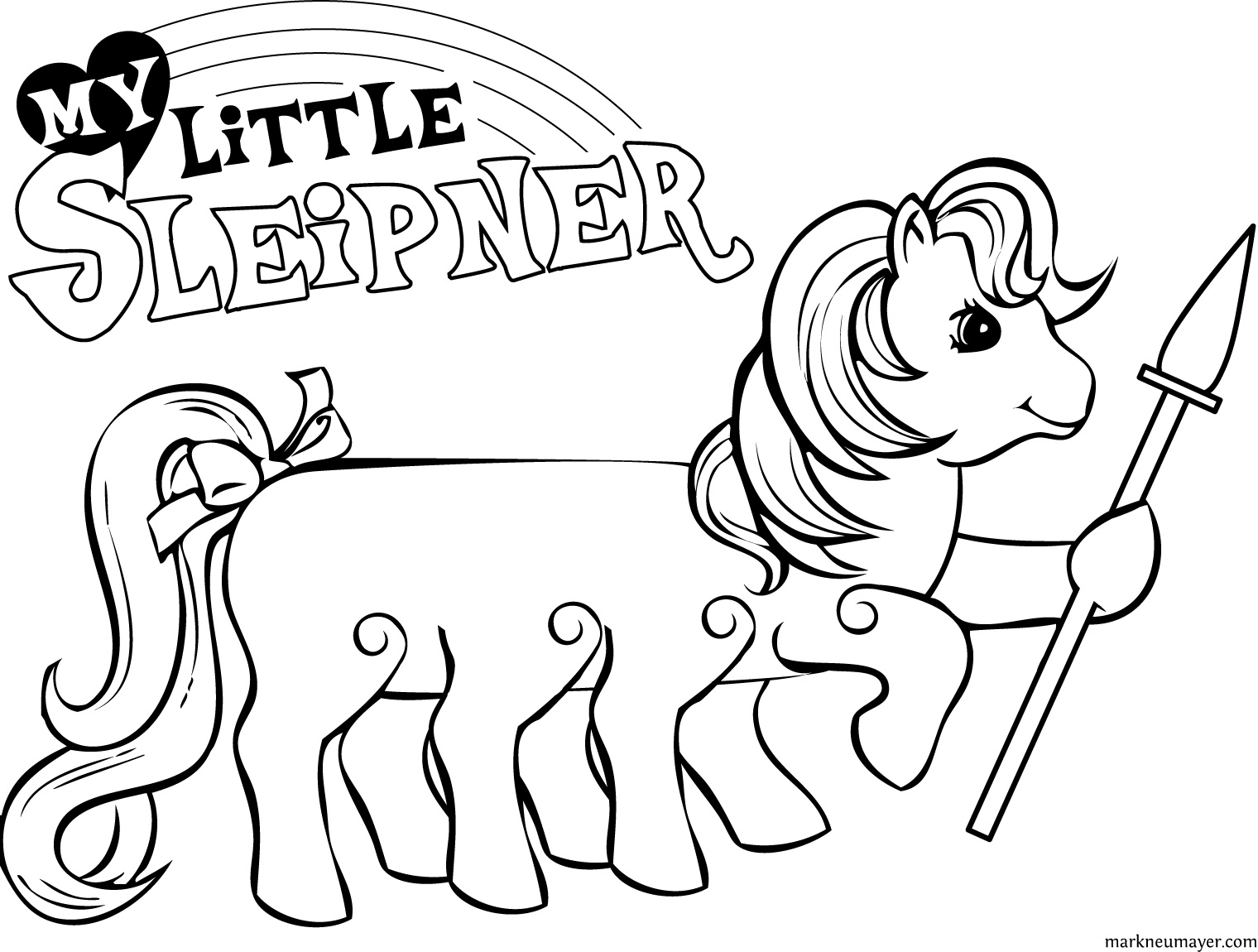
 I don’t know what to say about this week’s Norse-inspired mash-up. I’ve talked before about ideas that pop into my head and this was one of them. I just have to work it out in order to go on to something else. I am not saying I didn’t have fun making this little coloring page – it was fun. It just happened to be one of those ideas where even I am wondering “how does he think of these things?” Print it out and give it to the kids, or color it in yourself and have some fun.
Tag: Norse Mythology
Norse Mythology by John Lindow – A Review
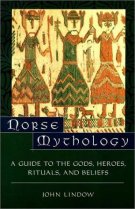 I got three new reference books on Norse mythology over the past few weeks and as I work my way through them I wanted to share some of my thoughts. If you have any favorite books on the subject feel free to give them a shout-out in the comments.
This week I have been reading Norse Mythology by John Lindow and I am very happy with it. If you’re looking for complete tales of the various gods, giants and what-not it won’t be your cup of tea. However, if you want an encyclopedic reference to help further your understanding of the Norse mythos, I can heartily recommend this book. For example, if I look up Glitnir I find:
- it is the hall of Forseti, Baldr’s son.
- I am told what saga or sagas mention it, often with specific stanzas
- cross-references are given within the book (i.e. see also Forseti)
- other scholarly papers are listed where relevant
The book does more than list the people and places of the myths. There are chapters on The Nature of Mythic Time and The Importance of Norse Mythology, as well as other overarching themes. I have complained more than once about sources that don’t list where their information comes from and this book definitely does NOT have that problem.
A clear writing style with touches of humor, numerous quality illustrations, and further reading suggestions all combine to make Norse Mythology by John Lindow a solid reference. If you are looking for a book that covers Norse mythology from Æsir to Yngvi, this is an excellent choice.
Who To Trust
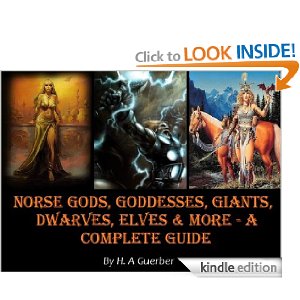 I’ve been reading Norse Gods, Goddesses, Giants, Dwarves, Elves & More – A Complete Guide by H.A. Guerber. It is a hefty book published way back in 1909 that really tries to live up to the subtitle’s claim of being “complete.” (I give it bonus points for being edited by A. Thor.) In addition to the many stories it also gathers together over 60 illustrations. I have the Kindle version which claims to have been “revamped” in 2011.
While I do recommend this book for any fans of Norse mythology, I have to deliver that recommendation with a very big caveat – I am not sure that I can trust all of the stories in this book. This isn’t a scholarly book – it has no index and there are numerous mentions of “various sources” without any naming of those sources.
Don’t get me wrong, the book is an enjoyable read. It presents its information in a clear straightforward style that is entertaining. I have read some other reviews where people complained that it had too many poetry excerpts. I can understand that is just a byproduct of the time when the book was written. My quibble with the poetry has more to do with the author using both quotes from the Eddas and later sources such as Longfellow and Wagner. The similar presentation subtly implies that all the poetry has equal merit in depicting Norse myths. But while I have a certain level of respect for Longfellow and Wagner and the work they have done in helping to popularize the Norse myths, I don’t look to them as experts in the field.
Yet this brings up another issue – how accurate was Snorri? Nancy Marie Brown has a fascinating series of blog posts titled Seven Norse Myths We Wouldn’t Have Without Snorri. In those posts she lays out her arguments for why she thinks Snorri didn’t just transcribe Norse legends, but made some of them up on his own. She makes some good arguments and the series is worth a read.
The whole issue of what the ancient Norse really believed is such a thorny one. We don’t have the written records for them like we do for the ancient Egyptians, Greeks and Romans. So we may never know definitive answers. And that is what can be so frustrating about this field and ultimately about Guerber’s book. I kept reading little bits and pieces of information and thinking “that’s so cool, I haven’t read that before.” But without some explanation about where exactly that nugget of information can from I am hesitant to use it. I’ve been burned by sources before – in my first book, Valda & the Valkyries, I have Loki claiming to be a fire god because that is what so many sources used to say. I’m a bit gun-shy now. It could be a result of living in the interconnected world of the internet where all the information I could want is at my fingertips. Unfortunately it happens to be mixed in with all of the misinformation that I don’t want and there aren’t always clear signs telling me which is which.
Ultimately I can recommend Norse Gods, Goddesses, etc … as an entertaining read and a good overview, but I would hesitate to endorse it as 100% accurate.
Loki Brownson
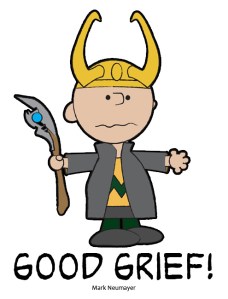 I have mentioned before that I don’t know where the ideas come from. Sometimes they slowly bubble their way up out of my subconscious. Other times they spring forth fully adult, like Athena bursting from the forehead of Zeus. (I know that’s Greek, not Norse, but I couldn’t think of a Norse example that fit as well.) The idea for this mashup sprang forth fully formed and I know from long experience that when I get an idea like this, I have to draw it to get it out of my head. Good grief, indeed.
Happy Thorsgiving
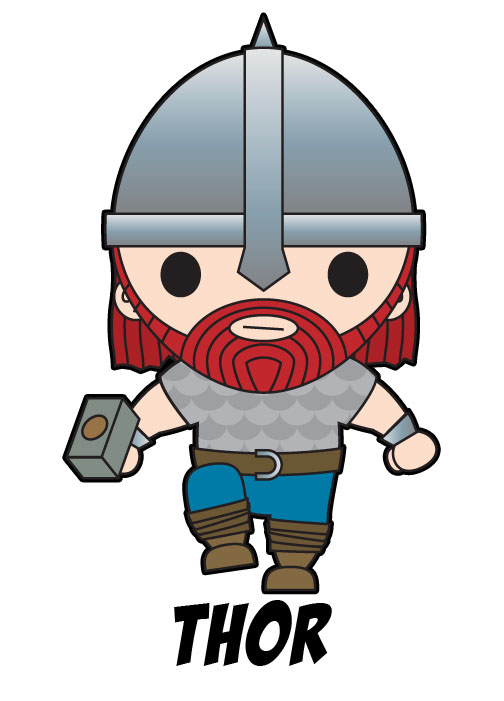 Thursday is Thor’s day and it is about time I offered up a kawaii version of the god of thunder. I’m sure my wife will be sad to see this sketch owes more to the Norse traditions than to the Marvel Comics edition. (She has a crush on Chris Hemsworth.) I’ve also gone with the traditional short-handled hammer. Loki kept messing with the Dwarves when they were creating some magical items for him. While the other items came out fine, the Trickster managed to distract the Dwarf working the bellows so that Mjolnir came out with a shorter than normal handle.
Happy Thanksgiving to everyone who celebrates it. Happy Thorsgiving to the rest of you.
Valkyrie Art
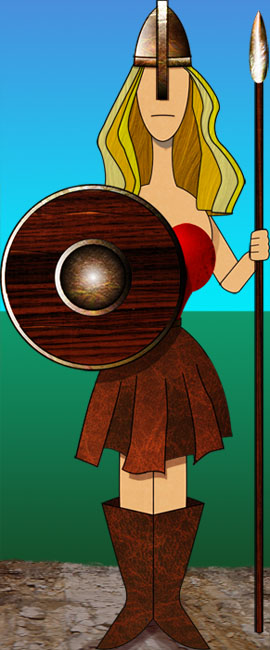 Hey, it’s Thursday so it’s time to post some Norse-themed art. Once again, this is in a different style from some of the stuff I have posted before. I can’t help it. Like Whitman said “I contain multitudes.” Except in my case it appears to be multitudes of artists who can’t decide on one way to draw things.
This stylized valkyrie was part of the background on the original cover for my book Valda & the Valkyries. I decided to polish her up and give her the spotlight treatment today.
Huginn and Muninn
In Norse mythology one of Odin’s many names is raven-god. He owes that to these two guys, Huginn and Muninn. Their names mean Thought and Memory and every day they fly around the world seeing what they can see before returning to bring their news to Odin at the end of the day. Ravens are popular in Norse art. You can find a number of images that show the ravens perched on the back or arms of Odin’s throne.
A passage from Grimnismal in the Poetic Edda has Odin stating:
-
I fear for Hugin, that he come not back,
yet more anxious am I for Munin.
That passage got me to wondering what would happen if Munin/Memory did not come back? What would happen if someone stole our memory? I ran with that idea a bit in my first book.
This week’s artwork was inspired by a gorgeous raven brooch that can be found on this page. I riffed a little on the design, adding some more knotwork.
That’s it for now. More superhero kawaii goodness coming up this Saturday.
Dwarven Valkyries
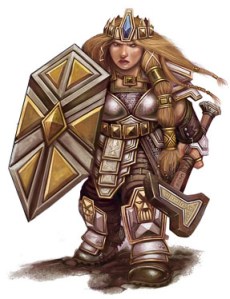
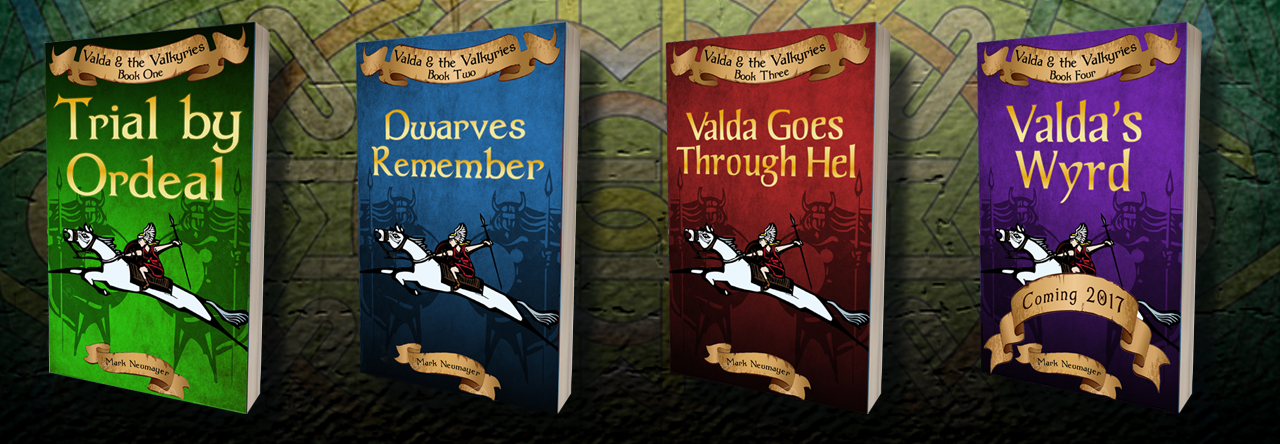
Usually when I write about mythology on the blog I am using the sagas as my source material (the Prose and Poetic Eddas, most often.) So I can understand how people might get a bit confused after reading the promo copy for my book Valda & the Valkyries. The book is about the adventures of a 15 year old Dwarf girl who becomes a Valkyrie. I want to be upfront about this – the book is fiction. While it is based on Norse mythology and uses characters from the myths, I made up the story. Also, I have not read any sagas that mention Dwarves being Valkyries. And yet the idea that a Dwarf could become a Valkyrie is not as crazy as it seems at first.
Bear with me for a bit as I first talk about the Norns. The Norns were the magical entities who ruled over the destinies of god and man. We know the names of the three most prominent ones: Urd, Verdandi and Skuld. Their names roughly translate to “that which happened,” “that which is happening” and “that which should occur” or, to be more blunt: past, present and future. Henry Adams Bellows writes
In Vafthruthnismol, 49, the Norns (this time “three throngs” instead of simply “three”) are spoken of as giant-maidens.
This, and one of the passages in Voluspa, could lead us to believe that the Norns are Jotun, or giantesses. However that may be, we are also told specifically that there are more than three Norns. The three chief ones we have already mentioned determine the destinies of mankind, the others watch over an individual throughout their life in a role similar to the Christian concept of the guardian angel.
Going to Voluspa again we can read:
‘Methinks the Norns were born far asunder, for they are not of the same race. Some belong to the Æsir, some to the Elves, and some are Dvalin’s daughters.”
Dvalin was a famous dwarf, so Dvalin’s daughters would be a kenning for dvergar, or dwarves. So in this passage we learn that the lesser Norns could be any of several races, including the Dwarves.
Back to the Valkyries – as I wrote about in this article, human maidens could, under the right conditions, become Valkyries. We also know that Skuld was a Valkyrie and a Norn and that she might have been a giantess. So while my conclusion is not official in any way, shape or form, it seems to me it isn’t that far-fetched to assume that a Dwarf, who we know could be a lesser Norn, could also become a Valkyrie. What do you think?
Guest post at Viking Runes blog
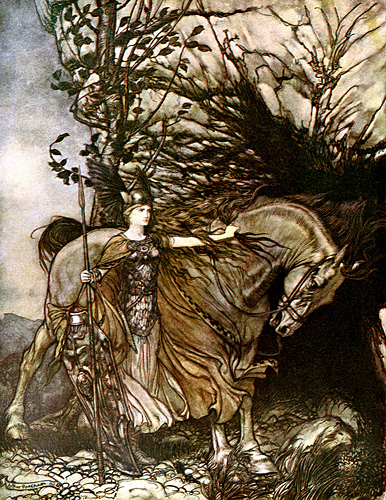
Just a quick mention that I did a guest post for the Viking Rune blog. You can find my article on the Valkyries here. It’s a bit more in-depth than the posts I write for my own blog.
And while you’re there you should check out some of the cool stuff on Victor’s site. There is a rune converter that will change your name or other English words into any of several different rune alphabets. There’s a app you can use to make your own Viking motto in Old Norse. He also has some interesting articles on different Viking runes and even an analysis of the Norse mythology links in the Max Payne video games and movie. Check it out!
The All-Father Gets His Cute On
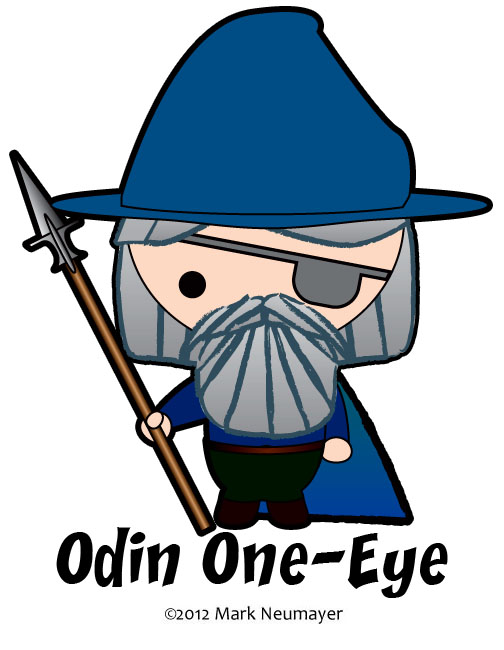 This week’s kawaii art offering features Odin himself. I cheated a bit on this picture. Odin loved to disguise himself and wander the countryside to see what he could discover. One element that all of his disguises shared was they all only had one eye. Odin famously traded his eye away to Mimir so that he could take a drink from the Well of Knowledge. So while I have the clothes resembling one of his disguises I couldn’t resist adding Gungnir into the mix. I don’t think it would be much of a disguise if you’re also carrying around a magical spear that never misses its target. Oh well..