Draugr are Coming

Draugr are the Norse version of the undead. (They play a rather prominent role in my third book Valda Goes Through Hel.) I’m surprised the draugr don’t receive more attention. With the success of Walking Dead and all things zombie it seems a natural, but that is starting to change. Case in point – Swedish film makers Karin Engman and Klas Persson are starting work on a film called Draug. It has a way to go before it reaches theaters but the sizzle reel looks like they got the creepy part of the myth done right.

Discovered via Dread Central

Limited Time Free Book Offer

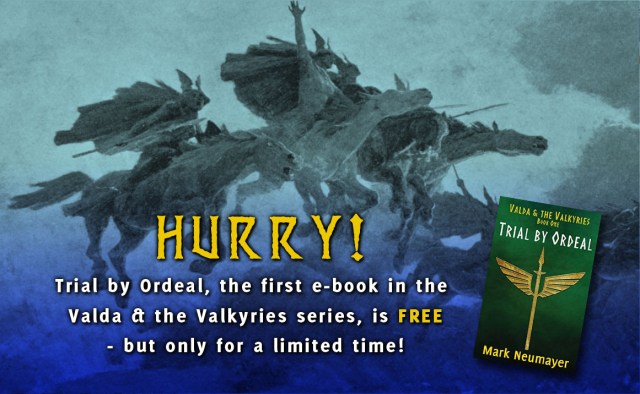
ValdaTBOpromoI am giving away the e-book edition of Trial By Ordeal, the first book in the Valda & the Valkyries series.
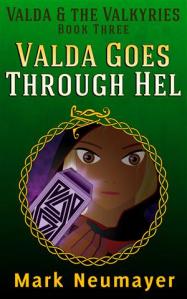
If you’re looking for a heart-warming story about a plucky heroine – this is it. If you’re looking for a light-hearted romp with the characters and creatures of Norse mythology – this is it. If you’re looking for an adventurous tale loved by boys and girls of all ages – this is it.

And for a short time it is my gift to you. Click here!

smallVGTHI have a giveaway running now on Goodreads. Two signed print copies of my book Valda Goes Through Hel are up for grabs. You have until the end of the month to sign up for your chance to win. Contest is open to the US, Canada, Great Britain and Australia.

Happy Winter Solstice

Skadi at YuleHi folks, it is that time of year again when the days reach their shortest length and the wheel starts turning again to bring us back towards the light of summer. Winter has been cold this year but I haven’t had to deal with anything as brutal as the 15 degrees below zero F that my friend John woke up to in Maine.

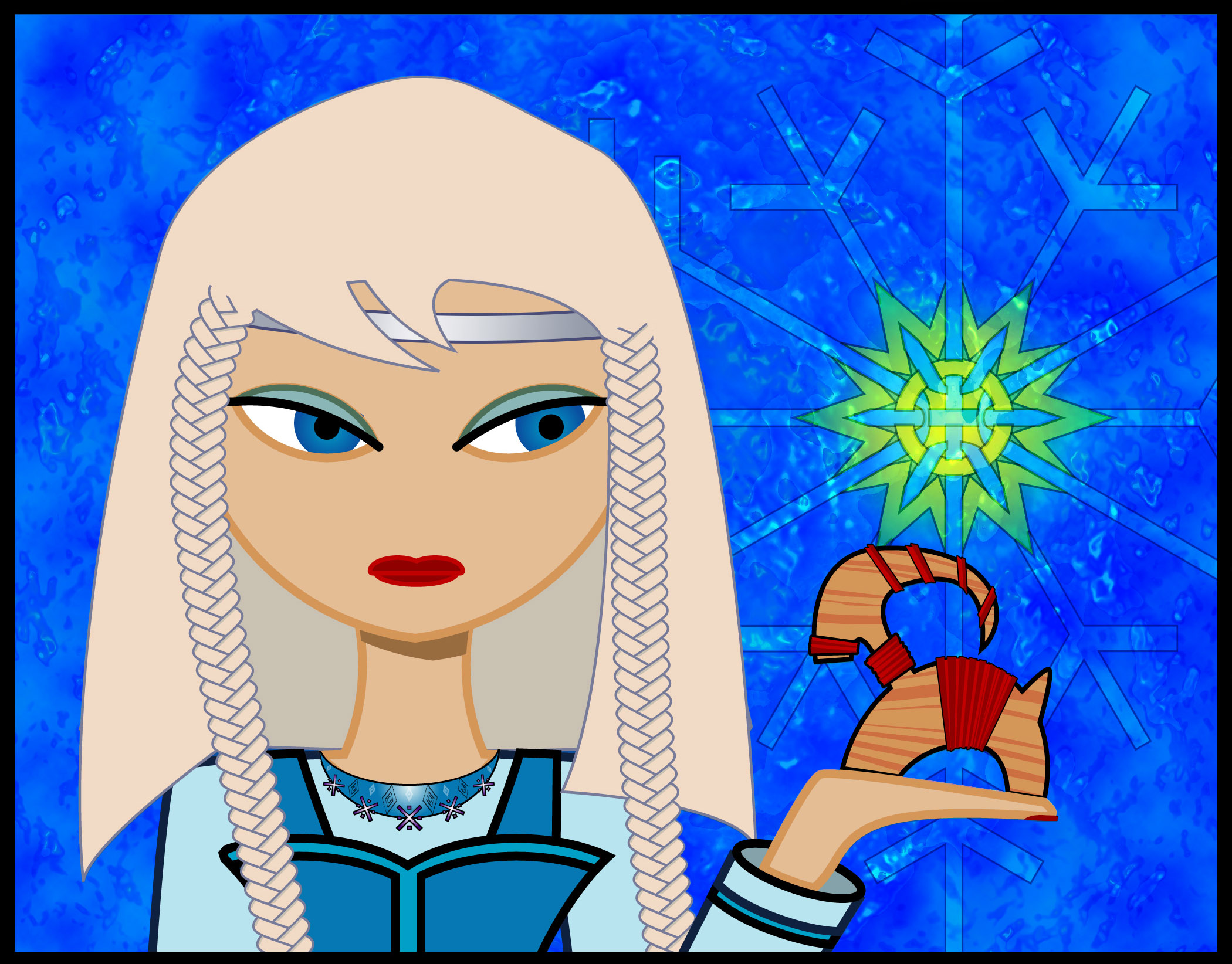
I did a piece of art for the Norse Mythology blog’s Midwinter Art Contest. Now that the contest is over and Yule is actually here I wanted to share the piece with you all. I can see my work and my style as an artist developing. I once had a producer friend of mine comment that what she liked about my work was that it morphed to fit whatever style was needed for the project. That’s good for a graphic designer but not so good for an artist who wants to develop their own visual voice and style.

I chose Skadi as my subject matter. Being the goddess of winter she was the first thing that popped into my mind. I have her wearing something a little dressier than her usual hunting attire since I  imagined her heading out to a Yule feast. The Yule Goat that she is examining is similar to the ones I have made for some of my friends this year. The knot work in the background expresses the idea of Midwinter for me: the icy snowflake dominates the scene but at the heart of it the sun, representing Summer, is ready to begin the yearly cycle once again.
Happy holidays, everyone!

Hammer of the Gods Coloring Page

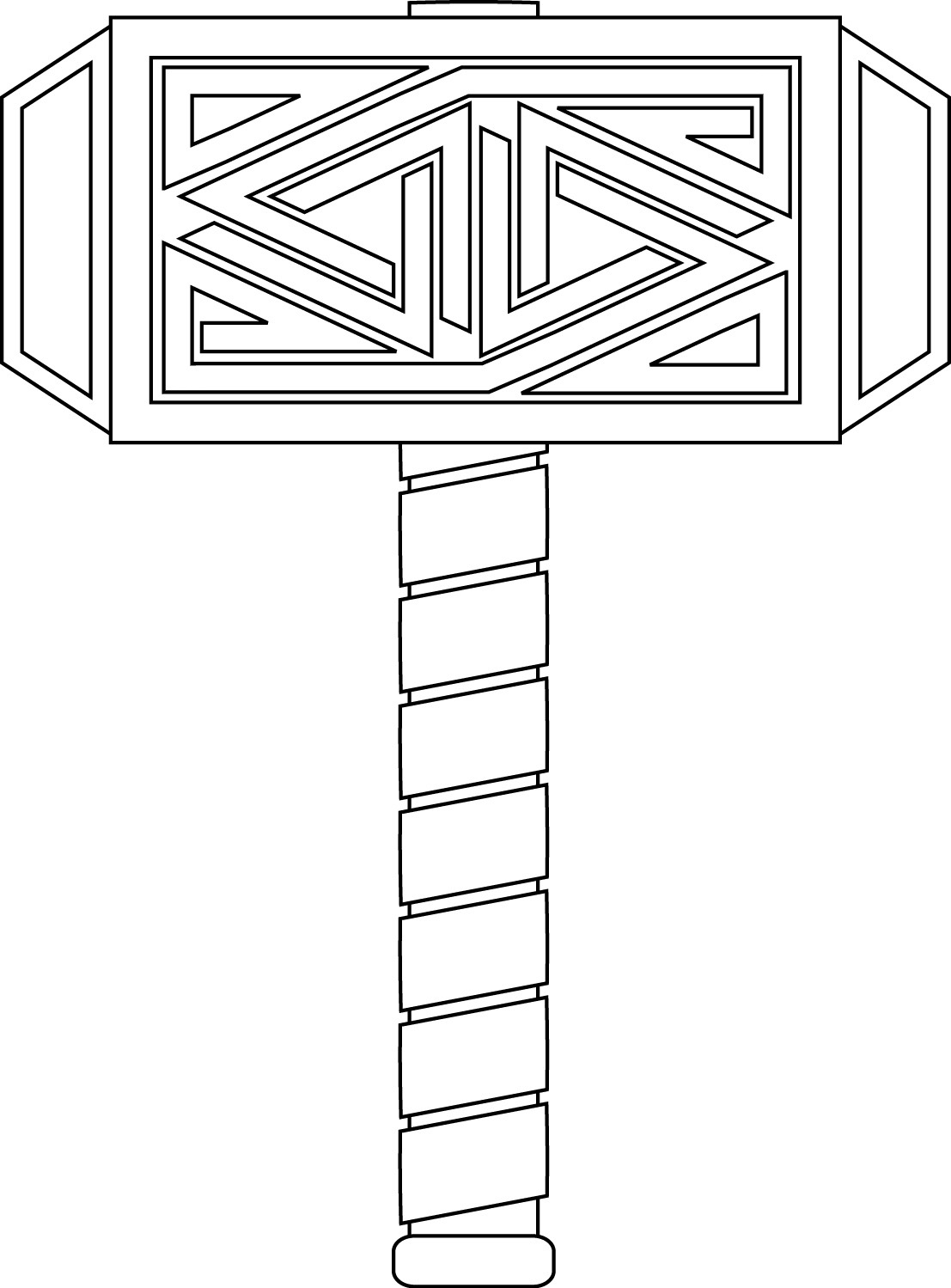
Hammer_coloringI drew this hammer as a detail for the cover of my next novel Valda Goes Through Hel. The whole artwork is still very much a work in progress but I was happy enough with the way this part turned out that I wanted to share a version of it with you. You can print it out and pass it on to your kids, or go ahead and color in yourself. Enjoy!

All-Seeing Odin

I’m working through the edits on my second novel Valda Goes Through Hel. It is a sequel to my first one Valda and the Valkyries and follows the title character on a difficult journey as she travels through the Norse land of the dead at the same time that she through one heck of an emotional wringer.

As I was working through some of the comments I got back from my great friend/first reader/editor Lyn Meany Robertson I came across a comment from her about how All-Seeing Odin did not foresee the outcome of a certain event. While I typed out a response to her comment it brought up an interesting train of thought that I wanted to share.

Odin has many different names. You can find a great list of them on this Wikipedia page. He is The Wanderer, Raven God, God of Wishes, Father of Victory and many, many more names including All-Seeing. But when I think of this last name I think it refers to his actual vision, in particular when he is seated on his throne Hlidskjalf. When he is seated there Gylfaginning tells us that “he looked out over the whole world and saw every man’s acts, and knew all things which he saw.” This strikes me as a reference to physical vision.

When Odin trades his eye in exchange for a drink from Mimir’s Well he gains knowledge of the future and the coming end of the gods at Ragnarok. But he still doesn’t know everything, he doesn’t see the outcomes of all of his actions. That sense of fallibility, that the gods are not all-knowing, runs through almost all of the Norse myths. The gods are not perfect: Thor loses his temper; Loki is a liar and a cheat; Odin steals the mead of poetry. For all of their might and power – they have human qualities. (I could just as well say that we have their qualities.) I think it is this humanity that makes their stories so appealing through the years. We still thrill to their legends because we see touches of ourselves within them. Faced with the often intimidating specter of an unknowable future, we can draw comfort from the fact that the gods in some small way share our journey.

Chariots of the Gods

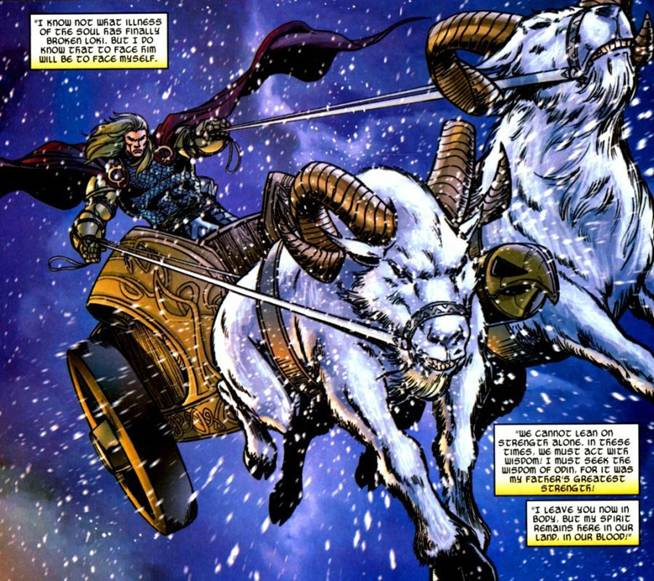
thors-chariotNo, we’re not talking about the late 60’s book or the 70’s documentary based on it. Today I’m talking about one of the favorite modes of travel for the Norse gods. The chariot pops up quite a bit in various sagas and myths, although sometimes it is called a cart and other times it is called a car. In all of the appearances there is usually something different to set this mode of travel apart from that used by ordinary folk. Let’s look at some of those cases.

Two of Every Animal
Although horses are the animal we most associate with chariots, the sagas liked mixing things up. Thor’s chariot was pulled by goats (we’ll talk more about this in a little bit) Frey’s was pulled by boars and Freya’s was pulled by cats. The last one brings up some crazy mental images for me since I imagine it would take a lot of cats to accomplish the task and it would take the powers of a goddess to get that many cats to do what you want them to do.

Thunder-cart
The Eddas list one of Thor’s names as Auku-Thor and tell us that this name means “Charioteer-Thor.” In addition, when Alvis the Dwarf visited Thor to ask for his daughter’s hand in marriage, he calls Thor “lord of chariots.” The god of thunder did in fact have a most impressive chariot. It was pulled by a pair of goats called Tooth-Grinder and Tooth-Gnasher. (Don’t think of them as the goats you might see in petting zoos. Norse goats are great, shaggy beasts with large, curving horns.) The rumbling of the chariot’s wheels as they rolled along was said to produce the sound of thunder. Thor was not allowed to drive his chariot over Bifrost the rainbow bridge for fear that this mighty rumbling would shake the bridge apart.

Brynhildr’s Hel-Ride
Brynhildr the Valkyrie, on her funeral pyre, was placed in a chariot lined with a rich tapestry. The Eddas tells of her then riding the chariot down to Hel. Along the way she encounters a giantess (who could have been Modgud, the guardian of the Gjallerbru – the bridge into Hel.) The giantess will not let her pass, stating that Brynhildr has pursued another’s husband and was “in evil hour born.” Brynhildr’s reply is bold and brash:
“From my chariot I will truly tell thee, thou witless crone! if thou desirest to know, how Giuki’s heirs made me both lovelorn and perjured.”

Light Vehicles
The chariot of Sol, the sun, was created by the gods from the sparks of fire that flew out of Muspelheim. Two horses pulled this chariot. The first was Arvakr “Early Awake” who was needed to make sure that the sun started its journey on time. The second was Alsvidr “Very Quick” who kept the chariot moving quickly enough that it would not scorch the earth beneath it. Skins full of cold air were placed beneath the withers of the horses to help keep them cool during their passage across the sky.
Mani, the moon, also runs “the round of heaven each day.” Unfortunately we don’t know any more about how he makes the journey. Assumptions can be dangerous but I think it is safe enough to assume he also has a chariot.

See you next time!

Best of Norse Mythology

People love ranking things. Search for Top Ten lists on the internet and you will get results for everything from the FBI’s top 10 fugitives to 10 bizarre theme parks from around the world. Writing such a list in this day and age seems to be a quick way to open yourself up to criticism. Luckily the internet was not around when the sagas were written and Grimismol told us all about the various best things in Norse mythology.

The Best of Food
Stanza 18 tells us about the magical boar Sæhrimnir, who has a confusing name since it means sooty sea-beast. This beast is cooked up by the chef “Sooty” in his huge cauldron “Fire-sooty” every night and supplies enough food to feed the entire host of Einherjar. Every morning the boar is reborn and ready to provide another night of delicious food.

The Best of Ships
Skithblathnir belonged to Freyr. The name means “wooden-bladed” and whenever its sails were raised a fair wind would appear to take the ship to its destination. The dwarves created this ship and although it is big enough to hold all of the gods and all of their weapons it can be folded down until it is small enough to fit in one’s pocket.

The Best of Trees
Yggdrasil, The World Tree earned this honor. Considering that this ash tree stretched from the depths of Hel all the way up to the heights of Asgard, that is no surprise.

The Best of Gods
Othin, or Odin, was called the greatest of gods. Some researchers have made the argument that Thor was more of a friend and guardian to the race of man than Odin. There is some merit to that argument but you should keep two things in mind. First of all, Odin was the ruler of the gods. Secondly, the poem Grimnismal is told from the point of view of Odin in disguise – who else is he going to say is the greatest?

The Best of Steeds
Sleipner, the eight-legged horse of Odin earns this distinction. Sleipner was born of Loki when the Trickster changed himself into a female horse to trick the giant who was building the walls of Asgard but Loki gave him to Odin. The grey horse was amazingly fast and even bore a rider down to Hel on more than one occasion. His name has worked its way into a number of kennings such as sea-slepnir – meaning a fast boat.

The Best of Bridges
Bifrost, sometimes appearing as Bilrost, is the rainbow bridge that connects Midgard and Asgard. The red color of the bridge is supposedly from flames that set the water beneath it to boiling. Bifrost is very strong and was constructed with incredible skill, but as good and strong as this bridge is there are two things it can not withstand: the chariot of Thor, god of Thunder; and the assault of the “sons of Muspell” during Ragnarok.

The Best of Skalds
Bragi, one of Odin’s sons, has this honor. It is not surprising since his name comes from the Norse word for poetry. He was sired by Odin while the ruler of the gods was stealing the mead of poetry from the giants. One of the things I find unusual is that Bragi was reported to be the only god that was welcome in all of the worlds. Everyone loves a good story or a sweet song and this god’s ability to share both of these things earned him friends wherever he went.

The Best of Hawks
Hobrok, or Hábrók, is reported to be the best of hawks, but unfortunately we have no other mention of him or her in the myths at all.

The Best of Hounds
Garm is the blood-stained hound that guards the gates to Hel. When Ragnarok comes he will burst his chains and run loose upon the world until he meets up with the god Tyr and the two of them slay each other. It is interesting that they choose a Hel-hound for the best of the category. Instead of going with a faithful companion animal or possibly a guardian type dog, Grimnismal basically chooses a monster for the best of hounds.


12 Homes of the Gods

The homes of the gods are mentioned, to greater and lesser degrees in the epic poem Grimnismal. I am working from the 1923 translation by Henry Adams Bellows. Most of them consist of two parts: the land in which the home is located (usually something-heim) and the name of the actual hall located in that land. Heim is from Old Norse and translate as “home, world or land” so Nifleheim becomes Mist Home or Mist World.

1. Thruthheim
means roughly “might world” or “place of might”. Here is where Thor lives in Bilskirnir, his immense hall that has 540 rooms.

2. Ydalir
translates to Yew Dales. Just as in England many years later, the wood of the yew tree was highly prized for use in bows in the ancient Northern lands. It makes sense that Ull (also called Ullr) the god of archery would want his home to be set among a grove of yew trees.

3. Alfheim
the home of the Elves is also the home of the god Freyr. It was given to him by the other gods as a tooth-gift – a present received when a child cuts its first tooth.

4. Valaskjolf
means shelf of the slain and this home of Odin has a roof thatched with silver. Bellows believes that this is another name for Valhalla but I am not too sure about that.

5. Sökkvabekk
translates to “sinking stream” and we are told how cool waves flow there. Odin is supposed to go there everyday to drink wine out of golden cups with the goddess Saga. Unfortunately this is one of the only mentions of Saga so we don’t know much about her..

6. Gladsheim
is the “land of joy” and another one of Odin’s homes. This is the realm where Valhalla is located, the hall where the valkyries bring Odin’s share of the bravest warriors who have died in battle. This is the one place Grminismal tells us the most about. That fits since the main character of the poem is Odin himself. He tells us the hall is easy to recognize because its rafters are spears and its roof uses shields for shingles. The benches within the hall are covered with breastplates (a sign of wealth.) Finally we are told a wolf guards the western door while an eagle hovers above it.

7. Thrymheim
is the land of clamor and the mountain home of the giant Thjazi. After his death his daughter Skadi married one of the gods and lived there.

8. Breithablik
breaks the pattern of homes we have been learning about since it does not end in heim. It seems to me as if we are to assume that the hall is in Asgard but that is conjecture on my part. Breithablik is the home of Baldr. Since Baldr has the reputation of being the fairest of the gods the land he makes his home is reported to be free from everything unclean.

9.  Himinbjorg
The name can be translated as heaven’s cliffs and it is located by the edge of Bifrost, the rainbow bridge. This is because it is the home of Heimdall, guardian of the bridge.

10. Folkvang
belongs to Freyja. The “field of the folk” holds the hall Sessrimner. Bellows casts some doubt on the idea that Freyja receives the slain warriors that do not go to Odin. I haven’t read anything about this doubt anywhere else. Other sources seem pretty clear that Freyja gets half of the Einherjar warriors.

11. Glitnir
is another hall that is roofed with silver although this one also happens to have pillars made out of gold. The name means shining and the hall is the fomeof Forsetti, the Norse god of justice/judgement.

12. Noatun
can be translated to mean Ship’s Haven and it is the home of Njorth (Njord). He governs the winds and is the one responsible for calming the seas and allowing smooth passage of ships.