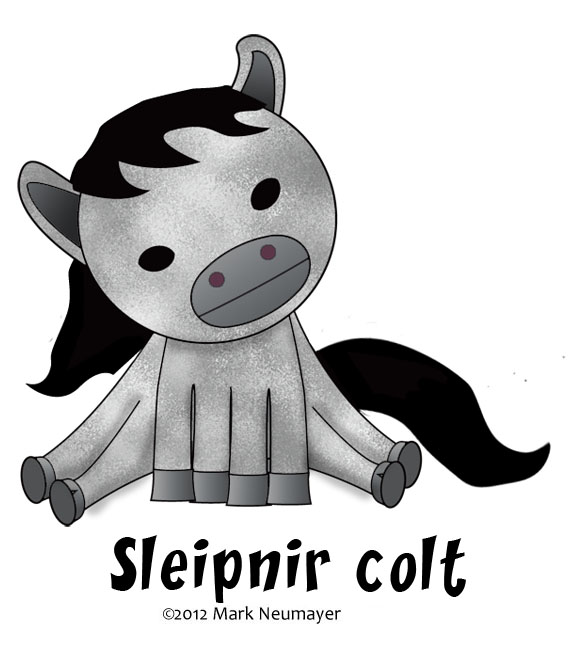
 Okay, we are back to kawaii-style artwork this week with the fourth of Loki’s children – Sleipnir. He is different from Loki’s other kids in a number of ways. First, although he does have eight legs, he is not a monster. Sleipnir, whose name means “slippery,” is a friend and servant of the gods and serves as the mount of Odin himself. Second, while Loki’s other kids were born to the giantess Angrboda, Sleipnir’s mother is… Loki. Yeah, confusing, I know. Loki is a shape-shifter. One time he needed to lure away a male stallion so Loki changed himself into a female mare. The plan worked and some time later Loki showed up with an eight-legged, grey foal. The sagas tell us “This is the horse Sleipnir, which excels all horses ever possessed by gods or men.” His most famous journey was when the god Hermod rode him to Hel while trying to free Baldur from the clutches of death.
Author: Nobody's Home
5 Sources for Learning About Norse Myths
 Part of writing is doing your research. Not that long ago this would have meant hours spent searching through dusty shelves and traveling to different libraries. Luckily we have the internet now and some great resources are brought right into our homes. This week I wanted to share some of the online resources I used while I was writing my novel Valda & the Valkyriesand it’s forthcoming sequel Valda Goes Through Hel. This isn’t meant to be an exhaustive list ( I have over 3 dozen links in my Norse reference bookmark folder) but it is certainly a great place to get started in your own studies.
The Viking Answer Lady
While there is information on this site about Norse mythology, the majority of it deals with various day to day information about the lives of the Vikings. Lots of good details to be found here about old Norse food, clothing, agriculture, warfare and more. Typical pages lay out solid information and give you a listing of resources where you can dig for more.
Sunnyway.com
This web site has a lot of information about the Norse runes. But, to quote them “The runes are inextricably bound to Norse mythology. One who aspires to be a user of runes needs a working knowledge of the mythology and writings of the runic era.” So what this site has done is put together an incredibly comprehensive listing of god, goddesses, giants, dwarves and wights. But they don’t stop there, going on to list different kennings and references and just tons more good stuff. They break it down into an alphabetical listing starting here.
Godchecker.com
This web site covers many different mythologies with a healthy dose of attitude. If you prefer a little snark and sass with your Norse research Godchecker.com is a good place to find information on over 102 gods, goddesses and various other creatures from the Norse mythos.
Wikipedia
While there have been questions from time to time about the accuracy of entries on this site, there is no argument that Wikipedia is the go-to site for online encyclopedias. So it’s no surprise that they have a lot of information on the Norse myths. The articles are generally well-written and close out with further reading suggestions and links. There is artwork referenced in many of the articles and those from Wikimedia Commons are even in the public domain and available for use.
Sacred-Texts.com
There is nothing like going straight to the source for your information. On this website you can find English translations of the Prose and Poetic Eddas along with many other sagas. Storytelling has not really changed that much over the centuries and the works found here are entertaining as well as educational.
Feel free to add any links that you’ve found useful in the comments!
The Heart is Bold that Looks on Gold
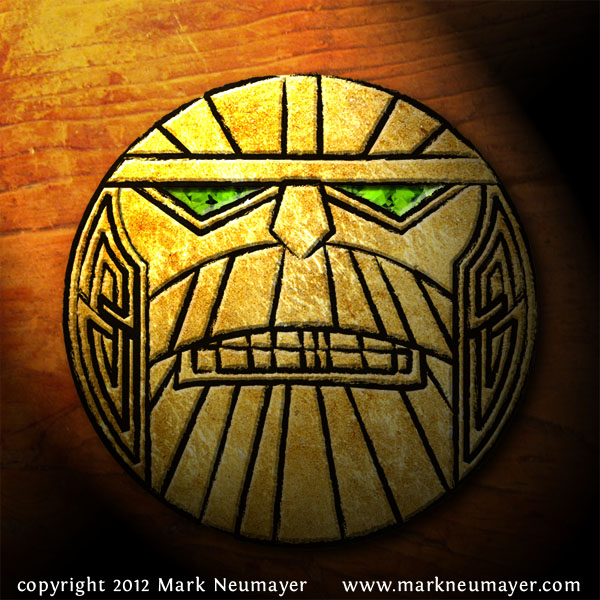 I’ve been posting kawaii artwork on Thursdays and I intend to keep on doing that. There is a problem with this week’s artwork – I don’t like it. I’m working on the kawaii version of Sleipnir but so far I haven’t been able to come up with anything I feel is good enough. (Those eight legs keep getting in the way of each other.) But I still wanted to post some kind of art so I did this piece.
I love the artistic style that Games Workshop uses for the Dwarves in their Warhammer game. It’s kind of weird because although I have read a lot of issues of White Dwarf magazine and pored over websites about the hobby I’ve never actually played the game.
The Dwarves in the game are very attached to their ancestors and frequently decorate weapons and armor with these little iconic representations of them. The GW artists have done a great job of invoking the look of the various carved images that we find on stones and wooden relics from the Norse countries. I did this piece to represent one of these icons before it is attached to a piece of armor.
I’m happy with the art although I do think the lines are too precise. This is a side effect of me creating the base in a vector drawing program. I’ve create my original lines and shapes in Adobe Illustrator and then bring it on over to Photoshop where I add textures and effects. I’ve been using both programs for over fifteen years so it is often easier for me to do something in the program than it is using paper and pencil. The knotwork is so much easier in the digital realm – you got to love that Undo button! If you’re interested in the process I use to create digital knotwork you can check out a tutorial I did. The tute is a few years old but all of the same principles still apply.
BTW, the line in the title comes from JRR Tolkien’s The Hobbit.
Posted by Mark NeumayerFast Facts About the Viking Undead
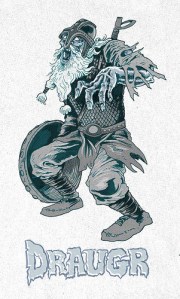
The Draugr
Zombies have been a mainstay of horror films and fiction for a long time. It’s not surprising to find out that they also had tales about them in the Norse sagas. There they were called draugr. I’ve been researching them since the draugr play a major part in my next book – Valda Goes Through Hel. Here are some fast facts about the Norse version of the undead.
Undead Sing the Blues
Although they were described sometimes as having pale flesh or skin as black as Hel, I think the scarier descriptions are those which tell about draugr with an evil blue skin color. The Norse were no strangers to living the rough life and we can expect they were intimately familiar with the various funky colors your skin can take on from various bruises and injuries. Imagine that sickly dark bluish tinge of a deep bruise covering every square inch of someone’s body. You would not want to run into something like that on a dark night.
Ch-ch-ch-changes
The draugr have also shown the ability to shape-shift. There stories where they assume the form of various creatures such as a seal, a bull, a horse and even a cat. While that last one doesn’t sound so menacing, once the draugr had assumed a cat’s form it would lay on the chest of a sleeping person and gradually get heavier and heavier until it crushed its victim to death.
That’s Heavy
It wasn’t just in feline form that the draugr possessed great weight. They were said to be heavier than a normal corpse. Some of them were described as having swollen bodies “as big as an ox.” This gave them great strength and they loved to use it to batter down doors and bash their way into the halls of the living. They would even indulge in an activity called house-riding. This consisted of the draugr climbing onto the roof of a house and drumming its heels against the roof to terrify everyone inside while they tried to bring down the rafters.
Hungry, Hungry Haugbui
Haugbui is another name for the undead. The name derives from the Norse word for barrows, or grave, so haugbui are grave-dwellers. The main difference seems to be that haugbui stayed relatively close to their graves while the draugr were more likely to roam the countryside. One of the traits that they did share was an immense hunger. There is a tale of a newly-risen draugr that eats the hunting hawk and dog that were buried with him. The next night he rises again and devours the horse that was buried with him. The third night he attempts to eat his friend who has been watching the gravesite. As a side note, that is indeed a good friend. Personally I think I would have been out of there after the first night.
While our Western image of the zombie draws more from the Caribbean influence of voodoo, it’s good to keep in mind the other traditions that have dealt with the undead. Norse mythology certainly has some great twists on the myths. If you want to read a more about draugr an excellent starting point would be this page from the Viking Answer Lady. Her site is a treasure trove of information about the ancient Norse and their ways.
When Fenrir Ate the Sun
Okay, I haven’t been in the habit of posting links, but this one is so cool that I wanted to share it. This isn’t a strict interpretation of anything from the sagas and I don’t know any of the story behind what is really going on. But this is a visually cool piece of animation depicting a monstrous dog eating the sun. Enjoy.
More Kawaii Artwork
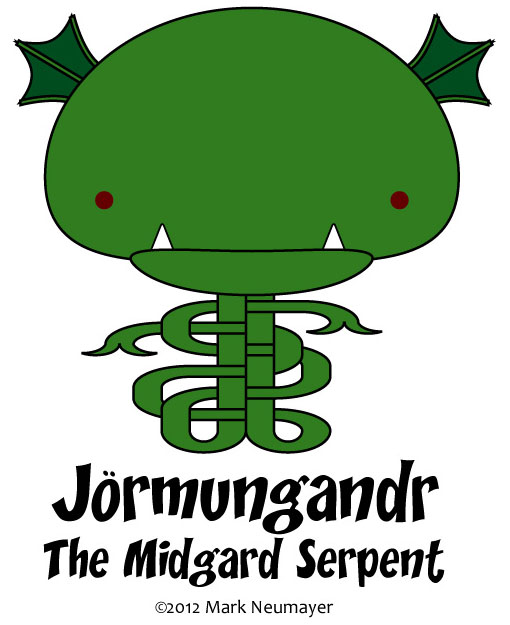 This week’s kawaii offering features Jormungandr. He is the colossal sea serpent that encircles the globe in Norse mythology. That’s really big, but I figure the guy couldn’t have been born that large even if his mother was a giant and his father was Loki. So we have my version of him when he was a wee lad.
This is the third in my series on Loki’s kids. We’ve covered Hela and Fenrir already so the only one left is Sleipnir. He’ll be racing onto the scene next week.
Talking About Trolls

Truly epic heroes need truly epic foes. I’ve talked about some of the heroes and creatures in Norse myths before now – this week we bring on the bad guys! The troll most of us know today has evolved considerably since ancient Norse times. The term started out as being a fairly generic term that could also describe a giant or an ogre. In some of the sagas the terms seem to be interchangeable. The one common thread is that trolls are almost never helpful to mankind. They “are perhaps not quite so huge (as giants) but strong, vigorous, unbalanced and nasty.” It was only under the influence of later Scandinavian folklore that the troll became a more distinct being and we see first mention of it being fairly unintelligent and turning to stone when exposed to sunlight.
Straight from the Source
One of the specific trolls mentioned in the Prose Edda is a unnamed troll woman. She tells the skald Bragi Boddason that “Trolls call me moon of dwelling-Rungnir, giant’s wealth-sucker, storm-sun’s bale, seeress’s friendly companion, guardian of corpse-fiord, swallower of heaven-wheel; what is a troll other than that?” So we have here established some associations with magic (seeress’ friendly companion) with the dead (corpse-fiord, meaning a grave) and with darkness (swallower of heaven-wheel – the sun.)
Tolkien’s Take on Trolls
The three trolls from The Hobbit follow closely along the lines of the mythical archetype – they are fairly stupid, large creatures who turn to stone when touched by sunlight. They also have a fondness for drinking beer. In LOTR Tolkien brings us many more examples of trolls, going so far as to break them down into different sub-categories: stone-troll, hill-troll, cave-troll etc… Treebeard the Ent says that trolls are a “mockery” of Ents. While some assume them to be a corruption of another lifeform, The Hobbit and LOTR both refer to sunlight turning trolls back into the stone from which they were made.
Detritus
Terry Pratchett’s Discworld series tends to go the comedic route with most things and their treatment of trolls reflects that. Pratchett’s take on the monsters has them constructed from stone. The exact stone varies from troll to troll and there are even trolls composed of brick and the notable Diamond King of trolls is made of the shiny gemstone. While he has done away with the blatantly evil part of the legend, Pratchett has kept the tendency of trolls to be dumb as, well, dumb as rocks. I like the variety of his trolls. They all have the same base core yet the stone they are composed of reflects their locale and origins. If you want to see how Pratchett handles them I would recommend Thud! There are some great scenes in there revolving around the down-on-his-luck troll named Brick.
The Boy Who Lived Through a Troll Attack
The fight with the troll in the girls’ bathroom is a pretty cool scene, especially in the movie version of HP&TSS. While it stays true to the idea of trolls as big and dumb, it doesn’t add much of anything to the lore. JK Rowling pretty much gave us the straight up troll mythos. I really debated whether or not to include this section. While it doesn’t add much to the troll mythos it is true to the older stories and it’s safe to assume that more people have seen this interpretation of trolls than any other one.
It Had to Be Goats
My first exposure to trolls was through the fairytale The Three Billy Goats Gruff in which a trio of goats defeat the troll who prevents them from crossing a bridge. The story is a Norse fairy tale that first saw print in the 1840s and saw it’s first English adaptaion ten or so years later. We can see here the early elements of trolls being evil creatures. We also see the size discrepancy that was common for the earliest depictions of trolls. It would have had to be a really large goat to knock down the sort of trolls we see in the LOTR or HP books. I do have to admit to not quite understanding why they were called “Gruff.” Granted the alliteration is there between goat and gruff. It’s interesting to note that the Norwegian words also begin with the same letter – bukkene and bruse. Maybe it was just to imply that these are the sort of rough and tumble goats that don’t let anyone push them around.
Hela Goes Squee
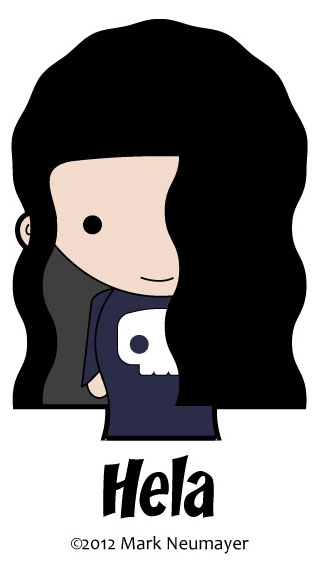 Okay, the other week I mentioned thinking about the Norse goddess Hela lately. Then I shared some kawaii artwork which featured her brother Fenrir. I had a picture of Hela done, but I wasn’t happy with it. It was a more modern take, making her into something of a Goth girl. While I like the concept, the execution just wasn’t working. I started from scratch and so this week I have a picture of Hela to share with you all. What do you think?
She’s smiling but my concept for these is that the children of Loki are still young and haven’t yet arrived at the grim junctures of their fates. So we can have her a little bit happy for awhile.
Two of Loki’s li’l ones down, two to go. I’m thinking I’ll feature Jormungandr next, thinking of a way to chibi-fy an 8-legged horse is a tough one.
I Put a 15-year-old Girl Through Hel
 I did, it’s true. Although I’m not talking about cyber-bullying (Is there an app for that?) or even real-life bullying. No, this was more along the lines of making life miserable for the heroine of my second novel.
If you’ve been reading my other blog entries you know that I’m into writing books based on Norse mythology. I started out with Valda & the Valkyries. Now I just finished the first draft of the second book in the series Valda Goes Through Hel. In this one I literally and figuratively put my spunky Dwarf heroine through Hel. She becomes aware of some troubling side-effects to being a Valkyrie, suffers the worst fate possible for a Dwarf, and has to lead a collection of scoundrels on a mission through Hel itself. For inspiration I followed pulp-writer Lester Dent’s advice:
Part one, hit your hero with a heap of trouble. Part two, double it. Part three, put him in so much trouble there’s no way he could ever possibly get out of it.
The manuscript is going out to my fantastic group of alpha readers now. I can’t say enough good things about how much I value their help. If you are a writer you know this already. Good alpha readers are a treasured commodity. Once I get their feedback and finish with the final edits I’ll be packaging it all together and getting it published as soon as possible.
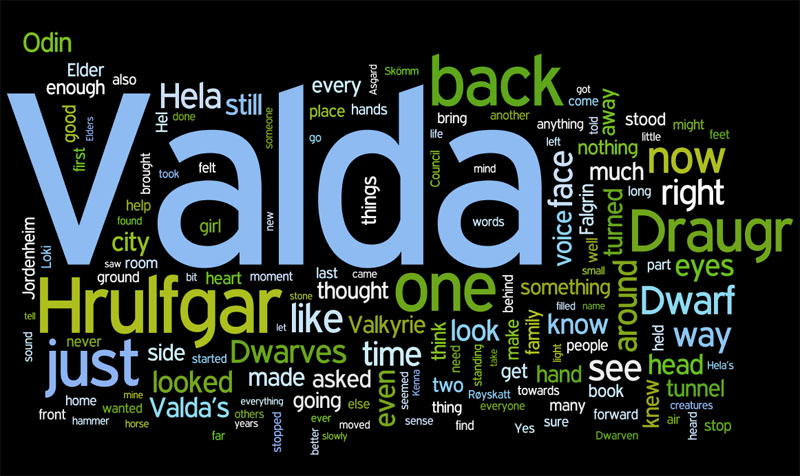
Today’s image comes to us through wordle.net I plugged the text into their nifty tool and got back this fun word cloud. The larger the word, the more often it appears during the text. You can see Valda is front and center and Hrulfgar is back as well, but who or what are Draugr? You ‘ll have to check back next week to find out.
Fenrir Pup
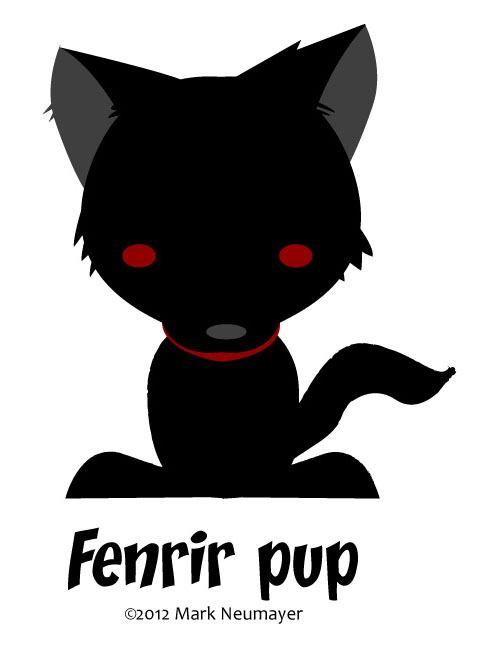 I’ve been thinking about the Norse goddess Hela lately, mainly because she plays an important role in the book I am writing Valda Goes Through Hel. I finished the first draft and have moved on to edits before I send the book off to my awesome group of readers. That means I am in the part of the book process where I don’t have to be as creative. So my mind is whipping off onto different tangents as it tends to do.
So I was thinking about Hela, which got me to thinking about the other children of Loki. There was Jormungandr, the sea monster better known as the Midgard Serpent. He eventually grew big enough to encircle the entire globe. There was Fenrir the giant wolf who bit off the hand of the god Tyr and is fated to kill Odin at Ragnarok. We also have Sleipnir, Odin’s 8-legged horse. Loki was not the father of this “best of horses,” he was the mother. Go here to read more about that if you want.
Definitely a strange batch of children and the thought popped into my head “I wonder what it was like raising that group of kids?” (I know normal people don’t think of things like that. I crossed that bridge many years ago, folks.) Thinking about them as kids lead me to doodling on the computer which lead me to today’s pictures. One of Loki’s li’l ones down, three to go.

